November 26, 2014

1967: Kelly & Browns Overcome Late Charge by Jurgensen & Redskins


The Cleveland Browns were 6-4 and, in this first season in which the NFL conferences were broken down into divisions, at the top of the Century Divison of the Eastern Conference as they hosted the Washington Redskins on November 26, 1967. Head Coach Blanton Collier’s Browns had an outstanding running tandem in HB Leroy Kelly (pictured at right) and FB Ernie Green. Despite assorted injuries, Frank Ryan was still an effective quarterback and had excellent receivers in split end Paul Warfield and flanker Gary Collins.

The Redskins were coached by an ex-quarterback, Otto Graham, and boasted an outstanding aerial game that generated lots of points. QB Sonny Jurgensen was an accomplished passer and had a receiving corps of split end Charley Taylor, flanker Bobby Mitchell, and TE Jerry Smith that was top rate. However, the running game was far less impressive and the defense could give up points as readily as the offense could score. Washington had a mediocre 4-4-2 record but was coming off of two straight wins.

There were 72,798 fans in attendance at Municipal Stadium in Cleveland. The Browns had the first possession and moved methodically and mostly on the ground with Leroy Kelly and Ernie Green carrying the load. Finally, Kelly took a flip from Frank Ryan and sped 42 yards for a touchdown to conclude the 10-play series. The venerable Lou Groza, in his 21st year at age 43, added the extra point.


Washington responded by advancing into Cleveland territory as Sonny Jurgensen completed four passes, but another was deflected by DE Paul Wiggin and LB Johnny Brewer (pictured at left) intercepted and returned it 70 yards for a TD. Groza’s PAT put the Browns ahead by 14-0.

The Redskins advanced quickly to midfield on their next possession. HB Gerry Allen ran around end for a 30-yard gain, and he and FB A.D. Whitfield combined for another 11 yards. Jurgensen threw to Charley Taylor for eight yards to reach the Cleveland 31, but the drive stalled there and, trying to convert a fourth-and-two situation, Jurgensen was sacked by Brewer.

The Browns punted to finish out the opening period and Washington started off the second quarter by going 59 yards in five plays. Jurgensen connected with Jerry Smith for 14 yards on a third-and-seven play and then threw to Taylor for a 23-yard touchdown. Gene Mingo converted and the home team’s lead was cut to 14-7.

Ryan threw to Paul Warfield for 23 yards as the Browns reached their 45 on the next series, but on the next play Green fumbled the handoff and CB Rickie Harris recovered for the Redskins. Jurgensen completed two passes to Whitfield, the second for 24 yards to the Cleveland 20, but three incompletions were followed by a 27-yard Mingo field goal. However, the Browns quickly expanded their margin again when DB Carl Ward returned the ensuing kickoff 104 yards for a touchdown. Groza’s point after made the tally 21-10.

Jurgensen again passed the Redskins into Cleveland territory, thanks to two completions to Bobby Mitchell, but after Allen was thrown for a loss on a running play, Taylor dropped a pass and, on third-and-12, Jurgensen was sacked to force the visitors to punt. It took the Browns just four plays to score again, with Ryan passing to Warfield (pictured below) down the left sideline for a 48-yard TD. Groza again converted and Cleveland was up by 28-10.


With less than four minutes remaining in the first half, Jurgensen came out passing on Washington’s next series. Five of them hit the mark, with the last to Taylor for a 15-yard touchdown. Mingo’s successful extra point again made it an 11-point contest. There was time enough for the Browns to make one last try to add points before halftime, and Kelly gained 30 yards on a sweep to near midfield. However, Groza’s field goal attempt from 42 yards was short and the score remained 28-17 at the intermission.

The Redskins had a short series and punted to start off the third quarter. Cleveland advanced 68 yards in six plays, the big one a swing pass by Ryan to Kelly that gained 48 yards to the Washington 21. A pass into the end zone drew a penalty for face-guarding and Green ran for the final yard and a TD. Groza’s extra point made the home team’s lead 35-17.

In response, the Redskins drove 75 yards. The hardly-nimble Jurgensen scrambled for 21 yards to convert a third-and-nine situation and he had back-to-back pass completions to Whitfield for 21 and 11 yards to reach the Cleveland 20. Now it was the turn of the Browns to make a penalty on a pass into the end zone, in this instance a pass interference call on DB Ben Davis, and Allen ran for a one-yard TD. Mingo converted and once more the margin was 11 points at 35-24.

The Browns had to punt on the next series after an unsportsmanlike conduct penalty moved them out of field goal range and Washington punted in turn. Cleveland was on the move as the game moved into the fourth quarter, helped along by the running of Kelly and Green and a 20-yard gain on a pass from Ryan to Gary Collins. Kelly ran for a 21-yard touchdown and Groza’s PAT staked the Browns to a big 42-24 margin.

The Redskins struck back quickly. On the fourth play of the ensuing series, Jurgensen went long for Mitchell and the result was a 48-yard TD. Mingo’s kick made the score 42-31. The teams then traded punts before Washington put together another scoring drive. Jurgensen completed four straight passes, two of them to Taylor (pictured below), and one to Whitfield for 12 yards to the Cleveland one, from where Allen went over for the touchdown. Mingo’s extra point attempt was partially blocked and hit the crossbar, thus keeping it a five-point margin.


There were less than three minutes remaining in the game and Kelly ran for 18 yards on Cleveland’s next play from scrimmage, but the Browns could get no more first downs and punted. With the clock down to 1:33, Jurgensen went to the air, completing passes to Jerry Smith for 17 and 21 yards and to Taylor for 19 to the Cleveland 25. But that was as close as the Redskins were able to get. The next three passes were incomplete, with one of them barely deflected by CB Erich Barnes in the end zone, and DE Bill Glass flattened Jurgensen on fourth down to effectively end the contest. Cleveland held on to win by a final score of 42-37.  

Washington had the edge in total yards (481 to 424) and first downs (33 to 19). Most of those yards came through the air as the Redskins generated 373 net passing yards, although Cleveland accumulated 203 yards on the ground. The Browns also recorded five sacks, to two by Washington, and each team turned the ball over one time apiece. Cleveland was penalized 10 times, at a cost of 148 yards, to six flags for 49 yards thrown on the Redskins. Ultimately, the interception and kickoff returns for touchdowns were the keys for the Browns.

Leroy Kelly rushed for 163 yards on 20 carries that included two touchdowns and also gained another 44 yards on two pass receptions. Frank Ryan didn’t go to the air often, completing 11 of 17 passes, but they were good for 233 yards and a TD while none were intercepted. Paul Warfield caught three passes for 96 yards and a score and Gary Collins contributed three receptions also, for 58 yards.

For the Redskins, Sonny Jurgensen had a huge performance in defeat, going to the air 50 times and completing 32 for 418 yards with three touchdowns against one interception. Three receivers went over a hundred yards, with Charley Taylor leading as he caught 11 passes for 123 yards and two TDs. Bobby Mitchell gained 106 yards on his 6 receptions that included a score and A.D. Whitfield accumulated 102 yards on 8 catches out of the backfield. Whitfield also rushed for 28 yards on 14 carries while Gerry Allen led the club with 59 yards on 14 attempts that included two short touchdowns.

The win kept the Browns a game ahead of the Giants in the Century Division and they stayed on top with a final record of 9-5. However, they were pulverized by the Cowboys in the Eastern Conference playoff. Washington ended up at 5-6-3 for third place in the Capitol Division.

Leroy Kelly passed the thousand-yard threshold for the second straight year with his fine performance against the Redskins and went on to lead the NFL in rushing with 1205 yards on 235 carries (5.1 avg.) and 11 touchdowns. He was a consensus first-team All-NFL selection and also was named to the Pro Bowl.


Sonny Jurgensen (pictured at right) set new NFL records with 508 pass attempts, 288 completions, and 3747 yards (Joe Namath threw for 4007 yards in the AFL). He also led the league in TD passes (31) and passing overall (87.3 rating) and was chosen to the Pro Bowl. The 418-yard performance against Cleveland ended up being the third-highest of his Hall of Fame career.

Charley Taylor was a consensus first-team All-NFL and Pro Bowl choice as he led the NFL with 70 pass receptions, which were good for 990 yards and nine TDs. Indeed, he, Jerry Smith, and Bobby Mitchell placed first, second, and fourth, respectively, among the league’s pass receiving leaders.

November 25, 2014

2001: Surging Bears Shut Down Vikings


The Chicago Bears were 7-2 as they took on the Minnesota Vikings on November 25, 2001 but had benefited from some good fortune in close games along the way. The Bears, who had not had a winning season in six years, were coached by Dick Jauron for the third season. Workmanlike QB Jim Miller directed a conservative offense that benefited from the presence of rookie RB Anthony Thomas. The tough defense was buttressed by the arrival of veteran newcomers on the line in DTs Ted Washington and Keith Traylor, plus the continued development of second-year MLB Brian Urlacher. However, they were without Thomas due to a hamstring injury and RB James Allen (pictured above) was starting in his place against the Vikings.

Minnesota reached the playoffs in each of the five previous seasons, but was stumbling along at 4-5 thus far in ’01 (including an earlier loss at Chicago), although the Vikings were coming off of an impressive win over the Giants the previous Monday night. Head Coach Dennis Green produced consistently strong offensive teams, and there was plenty of talent with QB Daunte Culpepper and wide receivers Cris Carter and Randy Moss. But the retirement of RB Robert Smith hurt and so did the tragic training camp death of OT Korey Stringer. Defense was a chronic problem.  

There were 64,214 fans in attendance for the Sunday night game at the Metrodome. The Vikings had the game’s first possession and moved into Chicago territory but were forced to punt, and that set the stage for the rest of the first quarter. Neither offense was able to move effectively. A 23-yard punt return by WR Nate Jacquet gave the Vikings good starting field position at the Chicago 44 at one point, but they came up empty when LB Rosevelt Colvin intercepted a Daunte Culpepper pass.

Finally, in the second quarter the Bears put together an 80-yard drive in seven plays. Jim Miller completed a pass to WR Dez White for 17 yards and RB Leon Johnson gained 34 yards on a carry to the Minnesota four. Two plays later, Johnson ran for a two-yard touchdown and, with Paul Edinger adding the extra point, Chicago was in front by 7-0.

Following more exchanges of punts, the Bears got favorable field position at the Minnesota 34 and, starting with a 15-yard run by James Allen, came away with a 30-yard Edinger field goal to lead by 10-0 at the half.

The Vikings finally got on the board on their first possession of the third quarter. Culpepper completed six passes to get from his 31 to the Chicago 26 and Gary Anderson booted a 44-yard field goal to narrow the Bears’ margin to 10-3.

That was it until, in a series that extended into the fourth quarter, the Bears moved 55 yards in eight plays. Miller completed passes to WR David Terrell that picked up 26 and 25 yards to reach the Minnesota 26 and, while the drive stalled, Edinger kicked a 43-yard field goal to again make it a ten-point contest.

After another exchange of punts, the Vikings put together a long series, the key play being a pass from Culpepper to TE Byron Chamberlain in a third-and-five situation that gained 23 yards to the Chicago 12. However, after getting another first down at the one, Minnesota couldn’t punch the ball in and had to settle for a 21-yard Anderson field goal.

That was effectively the last gasp for the Vikings. Taking over on offense with 3:10 on the clock, the Bears managed to maintain possession until the final seconds before having to punt, and pinned back in their own territory, time ran out on the Vikings. Chicago won the low-scoring affair by the final score of 13-6.

Minnesota failed to score a touchdown for the first time in 98 games but led in total yards (316 to 235), first downs (15 to 11), and time of possession (34:13 to 25:47). However, the Vikings also were called for 11 penalties, at a cost of 75 yards, to just two flags thrown on Chicago. Each team turned the ball over once and punted eight times apiece.


Jim Miller (pictured at left) completed just 10 of 21 passes for 97 yards, but gave up no interceptions. James Allen rushed for 107 yards on 27 carries while Leon Johnson ran the ball twice for 35 yards that included a TD and did well returning kicks, averaging 10.8 yards on four punt returns and running back one kickoff for 33 yards. Dez White had four catches for 32 yards and David Terrell gained 51 yards on his two receptions.

For the Vikings, Daunte Culpepper was successful on 26 of 46 throws for 209 yards, but failed to throw a TD pass for the first time all season and gave up one interception. He also rushed for 43 yards on seven carries. Rookie RB Michael Bennett gained 75 yards on 12 rushing attempts. Byron Chamberlain caught 7 passes for 56 yards and Cris Carter contributed 45 yards on five receptions, while Randy Moss was a negligible presence with four receptions for 25 yards and some dropped passes.

The Bears lost only one more game the rest of the way, finishing the regular season with a 13-3 record that put them on top of the NFC Cental. They lost to the Eagles in the Divisional playoff round. Minnesota collapsed, winning only one more time and ending up at 5-11 and fourth in the division. Coach Green was replaced by Mike Tice before the end, and Tice continued on as head coach for the next four seasons.

The defensive performance by the Bears was typical as they led the NFL in fewest points allowed (203). Ted Washington and Brian Urlacher were both consensus first-team All-NFL selections in addition to being named to the Pro Bowl.

November 24, 2014

Highlighted Year: Dan Abramowicz, 1969

Wide Receiver, New Orleans Saints


Age: 24
3rd season in pro football & with Saints
College: Xavier (OH)
Height: 6’1”   Weight: 195

Prelude:
Abramowicz caught 120 passes for 1685 yards and 14 touchdowns in college but was considered too slow by pro scouts and the expansion Saints took him in the 17th round of the 1967 NFL draft. He moved into the starting lineup midway through his rookie season and caught 50 passes for 721 yards (14.4 avg.) and six TDs. What Abramowicz lacked in speed he made up for with reliability and a knack for getting open. He followed up in 1968 with 54 receptions for 890 yards (16.5 avg.) and seven touchdowns.

1969 Season Summary
Appeared in all 14 games
[Bracketed numbers indicate league rank in Top 20]

Pass Receiving
Receptions – 73 [1] 
Most receptions, game – 9 (for 115 yds.) vs. Baltimore 10/19, (for 105 yds.) at Atlanta 12/7
Yards – 1015 [3]
Most yards, game – 129 (on 8 catches) vs. Pittsburgh 12/21
Average gain – 13.9
TDs – 7 [11, tied with Wendell Tucker, Joe Morrison & Dave Williams]
100-yard receiving games – 4

Rushing
Attempts – 3
Yards – 61
Average gain – 20.3
TDs – 0

Scoring
TDs – 7
Points – 42

Awards & Honors:
1st team All-NFL: AP, NEA
2nd team All-NFL: NY Daily News, Sporting News

Saints went 5-9 to finish third in the Capitol Division of the NFL Eastern Conference.

Aftermath:
Abramowicz followed up with 55 catches for 906 yards (16.5 avg.) and five touchdowns in 1970. While still a well-regarded possession receiver, his numbers dropped in 1971 and ’72 and he was traded to San Francisco during the 1973 season, where he caught 35 passes for 442 yards (12.6 avg.). Following one more year with the 49ers, he was briefly with the Buffalo Bills, catching no passes in 1975, his final NFL season. Along the way, he caught at least one pass in 105 consecutive games, which was the NFL record at the time. Overall, Abramowicz had 369 catches for 5686 yards (15.4 avg.) and 39 touchdowns. He was one of the first two players named to the New Orleans Saints Hall of Fame in 1988 (along with Archie Manning).

--

Highlighted Years features players who were consensus first-team All-League* selections or league* or conference** leaders in the following statistical categories:

Rushing: Yards, TDs (min. 10)
Passing: Yards, Completion Pct., Yards per Attempt, TDs, Rating
Receiving: Catches, Yards, TDs (min. 10)
Scoring: TDs, Points, Field Goals (min. 5)
All-Purpose: Total Yards
Defense: Interceptions, Sacks
Kickoff Returns: Average
Punt Returns: Average
Punting: Average

*Leagues include NFL (1920 to date), AFL (1926), AFL (1936-37), AAFC (1946-49), AFL (1960-69), WFL (1974-75), USFL (1983-85)

**NFC/AFC since 1970

November 23, 2014

1986: Kosar Passes for 414 Yards as Browns Defeat Steelers in Overtime


The Cleveland Browns were 7-4, but coming off of a bad loss to the Raiders, as they hosted their fierce rivals, the Pittsburgh Steelers, on November 23, 1986. Coached by Marty Schottenheimer, the Browns were benefiting from the rapid development of QB Bernie Kosar (pictured at right), who was two days short of his 23rd birthday. TE Ozzie Newsome was nagged by injuries, as were the running backs, but wide receivers Webster Slaughter, Reggie Langhorne, and Brian Brennan were steady.

The Steelers, under the guidance of Head Coach Chuck Noll for the 18th year, had gotten off to a 1-6 start but were now 4-7. QB Mark Malone was inconsistent but playing better after missing two weeks due to a thumb injury. Running backs Walter Abercrombie and Earnest Jackson were effective running behind a good line. The defensive line was lacking when it came to rushing opposing passers and CB Dwayne Woodruff, their best in the backfield at coverage, had gone down for the year in the preseason.  

It was a rainy day at Cleveland Municipal Stadium with 76,452 fans in attendance. The Steelers had first possession and drove 75 yards in eight plays. The big one was a pass from Mark Malone to WR Louis Lipps that picked up 44 yards to the Cleveland nine yard line. Walter Abercrombie ran for a one-yard touchdown and Gary Anderson added the extra point.

The teams exchanged punts before the Browns put together a promising drive. Bernie Kosar completed a third-and-10 pass to WR Clarence Weathers that gained 15 yards and throws to Brian Brennan picked up 28 and 21 yards. But after reaching the Pittsburgh four, a holding penalty nullified an apparent touchdown run and Kosar threw a pass that was intercepted by LB Bryan Hinkle.


The Steelers had to punt following a short series and Cleveland was again on the move as the game headed into the second quarter. Kosar connected with FB Kevin Mack for six yards and RB Curtis Dickey for four and two carries by Mack gained another nine yards. Kosar than threw to TE Harry Holt for 23 yards to the Pittsburgh 10 and, following a pass interference penalty, Dickey swept around left end for a two-yard TD to finish off the six-play, 53-yard series. Matt Bahr’s successful conversion tied the score at 7-7.

On Pittsburgh’s next offensive play, Malone’s errant pass was picked off by CB Mark Harper who returned it 31 yards to the Steelers’ 15. Five plays later Mack scored a touchdown from a yard out and, with Bahr kicking the point after, the Browns were now ahead by 14-7.

The Steelers responded with a scoring drive of their own that covered 61 yards in five plays. Malone completed two passes and Abercrombie took a pitchout and ran 38 yards for a TD. Anderson’s kick tied the score again at 14-14.

The Browns wasted no time in regaining the lead. Kosar threw to Webster Slaughter for 31 yards and passes to RB Herman Fontenot and Reggie Langhorne gained another 14 to the Pittsburgh 35. A defensive holding penalty was followed by a nine-yard run by Mack and Kosar then connected with TE Ozzie Newsome for a 20-yard touchdown. Bahr converted and the score was 21-14.

DB Lupe Sanchez returned the ensuing kickoff 58 yards to the Cleveland 40, but after the drive stalled at the 28, Anderson missed a 45-yard field goal attempt. With the clock down to 1:42 remaining in the first half, Kosar passed the Browns into Pittsburgh territory but Bahr was also unsuccessful on a 39-yard field goal try and the score remained unchanged at halftime.

Cleveland had the ball first in the third quarter and punted. The Steelers then drove 63 yards in nine plays to put more points on the board. Malone had completions to TE Preston Gothard for 19 yards and Lipps for 16. A pass interference penalty moved the ball to the Cleveland two and, two plays later, Malone scored a touchdown from a yard out on a quarterback sneak. Anderson knotted the score at 21-21 with the extra point.

The Browns responded strongly as Kosar completed three passes to Langhorne, the first for 20 yards in a second-and-17 situation and the second for 21 yards to convert on third-and-nine. A replay overturned  what was originally called a fumble by Kosar to keep the drive alive and Dickey finished off the 12-play, 76-yard series with a four yard touchdown carry. With Bahr adding the PAT, the home team was back on top by 28-21.


Pittsburgh was driving again as the game headed into the fourth quarter. Abercrombie (pictured at left) and Earnest Jackson had good gains and Malone converted a third down with an 11-yard completion to Lipps. Once again it was Malone keeping the ball himself for the final yard and a TD to cap the 11-play, 69-yard possession and, with Anderson’s extra point, the score was tied once more at 28-28.

Kosar went to the air on the next series and connected with Fontenot for 16 yards and Slaughter for 32 as the Browns advanced to the Pittsburgh 28. The drive stalled, however, and Bahr missed wide to the left on a 45-yard field goal attempt.

The Steelers went three-and-out and had to punt, and this time the Browns had a better result. Driving 64 yards in 14 plays, Kosar completed four passes and Mack and Dickey chipped away on the ground. A throw to Slaughter picked up 22 yards to the Pittsburgh 11 in a third-and-seven situation and, four plays later, Bahr made good on a 25-yard field goal try. Cleveland was up by three with 1:55 to play in regulation.

Starting from their 40 following the ensuing kickoff, the Steelers advanced 37 yards in nine plays. Malone hit on passes to Abercrombie for four yards and Lipps for 14. After RB Rich Erenberg dropped a pass with a clear field in front of him, he caught two throws from Malone for eight and five yards to get a first down. Finally, after two runs got the ball to the Cleveland 23, Anderson kicked a 40-yard field goal to knot the score at 31-31 with 11 seconds remaining, thus sending the game into overtime.

Cleveland’s placekicker Matt Bahr suffered knee ligament damage making the tackle on his last kickoff (which proved to be season-ending) and put the Browns at a disadvantage heading into OT because the reserve tight end Holt was the emergency backup and had never attempted a placekick in the NFL.

Both teams had short possessions to start the extra period. Cleveland WR Gerald “Ice Cube” McNeil had a 15-yard return that gave the Browns the ball at their 40. Mack ran four straight times to pick up 15 yards and Kosar, eluding a heavy rush in a third-and-seven situation, threw to Fontenot for another nine yards before connecting with Slaughter (pictured below) for a 36-yard touchdown to win the game by a final score of 37-31.


Despite the back-and-forth nature of the game and the closeness of the score, the Browns dominated in total yards (536 to 339), first downs (35 to 20), and time of possession (40:17 to 26:20). Each team turned the ball over one time apiece. Both teams had difficulties with field goals as Gary Anderson missed one from just inside 40 yards and Matt Bahr was unsuccessful on two of his three tries.

Bernie Kosar had a big performance, completing 28 of 46 passes for 414 yards and two touchdowns while giving up one interception. Webster Slaughter had 6 catches for 134 yards and the game-winning TD while Brian Brennan contributed five receptions for 87 yards and Herman Fontenot added 46 yards on his five catches. Kevin Mack rushed for 106 yards on 24 carries that included a touchdown.

For the Steelers, Mark Malone succeeded on 17 of 28 throws for 197 yards and was intercepted once.  Walter Abercrombie gained 86 yards on 15 carries that included two TDs and caught four passes for another 26 yards. Louis Lipps gained 85 yards on his four receptions and John Stallworth also caught four, for 48 yards.

“We felt like we could come in and shut them (the Browns) down,” said Pittsburgh defensive coordinator Tony Dungy. “We knew pretty much what they were going to do. We just didn’t get them stopped.”

Cleveland won its remaining regular season games to place first the AFC Central for the second straight year with a conference-best 12-4 record. The Browns defeated the Jets in the Divisional playoff round but lost the NFC Championship game to Denver. Meanwhile, the loss officially eliminated the Steelers from playoff contention. They ended up at 6-10 and third in the division.

Bernie Kosar passed for 3854 yards, which ranked fourth in the league, and threw 17 touchdowns with just 10 interceptions, giving him a league-low 1.9 interception percentage. He displayed his ability as a clutch performer by topping the NFL with seven game-winning drives. The 414 passing yards against the Steelers remained his career high.

November 22, 2014

1982: Raiders Overcome 24-Point Deficit to Beat Chargers in LA Debut


The Raiders made their long-delayed regular season home debut as a Los Angeles team against the San Diego Chargers on November 22, 1982. Having made the move from Oakland to LA in the face of much resistance from the NFL, the Raiders won their first two games on the road before the 57-day players’ strike put the entire league on hiatus.

The Raiders, coached by Tom Flores, fell to 7-9 in ’81, which was their first sub-.500 record since 1964, and were looking to rebound. QB Jim Plunkett had been troubled by injuries but was healthy again and HB Marcus Allen (pictured above), the first draft choice out of USC, was a welcome addition to the offense – indeed, the game against the Chargers marked his return to the stadium where he had starred in college and won the Heisman Trophy. Todd Christensen took over as starting tight end in place of the injured Derrick Ramsey with promising results. On defense, DE Lyle Alzado was obtained from the Browns and combined with second-year DE Howie Long to provide an enhanced pass rush.

San Diego came into the game at 1-1 following the long layoff. Under offensive-minded Head Coach Don Coryell, the Chargers boasted the league’s most prolific passing attack, guided by QB Dan Fouts and including TE Kellen Winslow and wide receivers Charlie Joiner and Wes Chandler. RB Chuck Muncie provided power and all-purpose RB James Brooks speed.

Skies were overcast for the nationally-televised Monday night game at the Memorial Coliseum with just 42,162 fans in attendance. Fans were disgruntled from the long work stoppage and, as was the case at other locales in this first post-strike weekend, there were many no-shows. The Chargers had the first possession and drove 79 yards in 12 plays. Dan Fouts was quick to go to the air and completed six passes along the way, the longest to TE Eric Sievers for 21 yards, and two penalties on the Raiders helped the visitors along. But with first-and-goal at the one, three carries by Chuck Muncie netted a loss of a yard and Rolf Benirschke kicked a 19-yard field goal.

The Raiders were forced to punt following their first series and San Diego moved quickly to another score, advancing 83 yards in just four plays. Following a five-yard run by Muncie, Fouts (pictured below) connected on passes of 12 yards to Sievers and 22 yards to Charlie Joiner. A personal foul on the Raiders added another ten yards and then Fouts threw to WR Dwight Scales for a 29-yard touchdown. Benirschke added the extra point and the Chargers were ahead by 10-0.


QB Jim Plunkett was intercepted by FS Tim Fox on the next possession, but while Fouts completed passes to Muncie for 27 yards and three to WR Wes Chandler that picked up a total of 41 yards, the Chargers ultimately had to punt. As the game headed into the second quarter, the Raiders also punted and, with good starting field position at the LA 48, San Diego moved quickly down the field. Fouts had completions to Chandler for 24 yards and Kellen Winslow for 19 yards to reach the five yard line, and two plays later Muncie ran up the middle for a two-yard TD. Benirschke added the point after to make it a 17-0 contest.

The Raiders moved well on their next series as Plunkett completed three passes, the longest to WR Malcolm Barnwell for a gain of 25 yards. Marcus Allen picked up 15 yards on a sweep and HB Greg Pruitt ran for another 13, but after reaching the San Diego 29, Plunkett was sacked by DE Leroy Jones for an 11-yard loss and then was intercepted by LB Cliff Thrift. The Chargers made the most of the turnover, going 57 yards in six plays, although it was a 42-yard pass interference penalty on CB Ted Watts that moved them all the way to the LA two. Muncie dove for a one-yard touchdown shortly thereafter and, with Benirschke’s PAT, the visitors extended their lead to 24-0.


Now in a deep hole, the Raiders stormed back. Plunkett completed five passes, with throws to WR Cliff Branch for 16 yards and FB Kenny King (pictured at left) for 28. Allen ran effectively, including a 17-yard carry on a trap play. But Plunkett was again thrown for a loss while rolling out on a third down play and Chris Bahr missed wide to the left on a 36-yard field goal attempt.

LA got a break on the next play, however, as Muncie fumbled the handoff and LB Ted Hendricks recovered for the Raiders at the San Diego 17. Five plays later, Plunkett connected with TE Todd Christensen for a one-yard touchdown to finally get the Raiders on the board. Bahr converted and the score was 24-7 at halftime.

The Raiders punted after a short series to start the third quarter and the Chargers lost ground due to two penalties and a sack of Fouts by Hendricks. Maury Buford punted and the shanked kick traveled only 27 yards to the LA 36. Plunkett came out throwing, hitting Christensen twice for 11 and 12 yards. King and Allen then combined for 40 yards on the ground with the star rookie gaining the last three for a TD. Bahr added the PAT and San Diego’s lead was cut to ten points at 24-14.

Following the kickoff, Fouts threw to Winslow for 21 yards to midfield, but three plays later Winslow fumbled when hit by DB Odis McKinney after catching a short pass and NT Ruben Vaughn recovered for the Raiders. LA scored again in four plays, highlighted by King running for a 21-yard gain up the middle, and Allen swept for the last three yards and another touchdown. Bahr’s extra point made it a three-point game.

The teams traded punts to finish out the period and San Diego started off the fourth quarter with a drive to the LA 15. James Brooks picked up 23 yards on three carries and Fouts had passes to Winslow for 15 yards and Chandler for nine. But the Chargers came up empty when Benirschke missed a 22-yard try for a field goal.

The Raiders responded by going 80 yards in nine plays. Plunkett was successful on three passes, including one to Christensen for 24 yards on a third-and-three play, and Barnwell gained 14 yards on a reverse. FB Frank Hawkins ran for a one-yard TD, Bahr added the point after, and the home team, once down by 24 points, was in front by four with 5:54 remaining to play.

San Diego fought back as Fouts fired to Chandler for completions of 30 and 24 yards. But after getting to the LA 18, Fouts threw into the end zone under a heavy rush and was intercepted by FS Vann McElroy. It in effect clinched the game for the Raiders as, with 1:56 remaining on the clock, they were able to maintain possession until the final seconds when Fouts threw a last desperation pass into the end zone that was batted away to nail down the 28-24 comeback win for Los Angeles.

The Chargers gained more total yards (411 to 326) and had the edge in first downs (26 to 23), but they also turned the ball over four times, to two by LA. The Raiders were dominant on the ground (181 yards to 72).

Marcus Allen rushed for 87 yards on 18 carries that included two touchdowns and caught 5 passes for 37 more yards. Jim Plunkett completed 18 of 25 passes for 163 yards and a TD while giving up two interceptions. Kenny King contributed 68 yards on 13 rushing attempts. Todd Christensen topped the club with 8 catches for 83 yards and a TD.

For the Chargers, Dan Fouts was successful on 24 of 42 throws for 357 yards and a touchdown while tossing two interceptions. Kellen Winslow (pictured below) caught 8 passes for 105 yards and Wes Chandler gained 118 yards on his 7 receptions. Chuck Muncie had six catches for 50 yards but was held to 23 yards on 15 rushing attempts that included two for TDs. James Brooks topped the club with 49 yards on eight carries.


"I don’t know what it is about Monday night football, but we’re very proud of our Monday night record,” said Coach Tom Flores, commenting on the fact that the come-from-behind win gave the Raiders a 19-2-1 record in Monday night contests.

The Raiders lost at Cincinnati the next week but didn’t drop another game during the remainder of the truncated regular season, finishing atop the AFC with an 8-1 record. With the divisions set aside, LA was the top seed in an eight-team conference postseason tournament and handily defeated the Browns in the first round before losing to the Jets in the second. San Diego, which lost to the Raiders again in the season finale, ended up at 6-3 and fifth-seeded in the AFC. The Chargers also won their first round game at Pittsburgh and lost to Miami in the second round.

Marcus Allen continued to have an excellent first season, receiving consensus first-team All-NFL and Pro Bowl honors as well as Rookie of the Year recognition. He rushed for 697 yards on 160 carries (4.4 avg.) and caught 38 passes for another 401 yards to lead the league in yards from scrimmage with 1098. His 14 touchdowns also led the circuit, as did his 84 points, making him the first rookie to lead the NFL in scoring since Gale Sayers in 1965.

As he had in each of the previous three seasons, Dan Fouts led the NFL in passing yards with 2883 and also topped the circuit in TD passes (17, tied with Terry Bradshaw and Joe Montana) and yards per attempt (8.7). Kellen Winslow led the AFC in pass receptions (54) and Wes Chandler topped the league in pass receiving yards (1032). All three received consensus first-team All-NFL honors and were selected to the Pro Bowl. 

November 21, 2014

Rookie of the Year: Brian Urlacher, 2000

Linebacker, Chicago Bears


Age:  22
College: New Mexico
Height: 6’4”   Weight: 249

Prelude:
Converted to linebacker as a freshman in college, Urlacher had two nondescript seasons before Rocky Long became head coach at New Mexico and gave him an enhanced role in which he acted as a defensive back as well as linebacker. The versatile Urlacher also saw action as a kick returner and wide receiver, the latter role in which he caught six touchdown passes. As a junior, he led the team with 178 tackles and received All-Mountain West Conference honors and in 1999 he was credited with 148 tackles and five forced fumbles. He received All-America recognition from several sources and was the first round draft choice of the Bears in 2000. Urlacher had an immediate impact as he proved to be ideally suited to playing middle linebacker with his speed and tackling ability in the open field, as well as excellent instincts.

2000 Season Summary
Appeared in all 16 games
[Bracketed numbers indicate league rank in Top 20]

Sacks – 8
Most sacks, game – 2 vs. Minnesota 10/15
Interceptions – 2
Most interceptions, game – 1 vs. Detroit 9/24, vs. Tampa Bay 11/19
Int. return yards – 19
Int. TDs – 0
Fumble recoveries – 1
Forced fumbles – 0
Tackles – 101
Assists – 24

Awards & Honors:
NFL Rookie of the Year: Sporting News
NFL Defensive Player of the Year: AP, PFWA
Pro Bowl

Bears went 5-11 to finish fifth in the NFC Central.

Aftermath:
Urlacher was selected to the Pro Bowl in each of the next three seasons and was a consensus first-team All-NFL selection in 2001 and ’02. After being limited to nine games in an injury-plagued 2004 season, in ’05 he was named NFL Defensive Player of the Year by the Associated Press in addition to receiving All-NFL and Pro Bowl honors. Urlacher was again a consensus first-team All-Pro and Pro Bowl selection in 2006 as the Bears won the NFC Championship. He began to show signs of wear later in the decade and, after typically being a durable player, missed all but one game in 2009 due to a wrist injury in the opening contest. But Urlacher returned to Pro Bowl form in 2010 and ’11 before finishing his career in 2012. Overall, over the course of 13 seasons and 182 games, he accumulated 41.5 sacks, 22 interceptions, 15 fumble recoveries, and over a thousand tackles. He scored five touchdowns, one of which came on his only pass reception. Urlacher was a consensus first-team All-NFL selection four times and was chosen to eight Pro Bowls.

--

Rookie of the Year Profiles feature players who were named Rookie of the Year in the NFL (including NFC/AFC), AFL (1960-69), or USFL (1983-85) by a recognized organization (Associated Press – Offense or Defense, Newspaper Enterprise Association, United Press International, The Sporting News, or the league itself – Pepsi NFL Rookie of the Year).

November 20, 2014

1994: Rice Has 16 Catches, 3 TDs as 49ers Overcome Rams


The San Francisco 49ers were cruising along at 8-2 as they hosted the rival Los Angeles Rams on November 20, 1994. Head Coach George Seifert’s team had an outstanding offense built around the nucleus of QB Steve Young, WR Jerry Rice (pictured at right), and RB Ricky Watters, and there were plenty of other fine players around them. The defense benefited from the addition of CB Deion Sanders and was anchored by young DTs Dana Stubblefield and Bryant Young.  

The Rams, coached by Chuck Knox, were struggling at 4-6 and had been beaten handily by the 49ers at home earlier in the season. QB Chris Miller was talented but injury prone and RB Jerome Bettis was having difficulty duplicating his first-year exploits, although rookie WR Isaac Bruce was showing promise.

There were 62,774 fans in attendance for the Sunday night game at Candlestick Park. The 49ers took the opening kickoff and drove 72 yards in eight plays. Steve Young completed five passes, three of them to Jerry Rice and the last to WR John Taylor for a seven-yard touchdown. Doug Brien added the extra point.

The Rams responded with a seven-play drive of their own that covered 48 yards. Chris Miller was sacked by DT Bryant Young for a loss of eight yards on first down and had to leave the game, but backup QB Tommy Maddox completed passes to RB David Lang for ten yards and WR Todd Kinchen for 39 to the San Francisco 21. Los Angeles reached the 14 before the drive stalled and Tony Zendejas kicked a 31-yard field goal.

San Francisco put together another methodical drive of 67 yards in 13 plays. Young completed five more passes, two of them to Ricky Watters and two to Rice, the second for a seven-yard TD. Brien converted and the Niners took a 14-3 lead into the second quarter.

LA benefited from a roughing-the-passer penalty on Miller, who was back in the game, and two completions to Isaac Bruce picked up 18 yards to the San Francisco 10. Once again the Rams were unable to reach the end zone, but Zendejas added another field goal from 27 yards to narrow the home team’s lead to 14-6.

The scoring parade finally ended as the teams exchanged punts. Starting from their own eight, the 49ers advanced 92 yards in 12 plays. Watters gained 22 yards on two carries to start, RB Dexter Carter ran twice more for 17 yards, and Young completed five passes and scrambled once for a first down. Rice again had two catches, and again the second was good for a touchdown, this time from six yards out. Brien added the PAT and the Niners took a 21-6 lead into halftime.

The Rams took the second half kickoff and drove 70 yards in six plays, the biggest of which was an end-around in which Kinchen raced 44 yards for a TD. The try to pass for two points failed and the score stayed at 21-12.

Once again the 49ers moved effectively down the field. Young had completions to Rice for 29 yards and Watters for 14, but this time they ended up with a field goal by Brien from 28 yards, still keeping them comfortably in the lead by 24-12.

LA faced a third-and-12 situation on its next series but Miller completed a pass to Kinchen for the needed yards and, three plays later, the Rams pulled off another big play when Miller threw long down the left sideline for WR Willie “Flipper” Anderson, who beat Deion Sanders and went the distance for a 50-yard touchdown. Zendejas added the extra point and the visitors were now just five points behind at 24-19.


On San Francisco’s second play after the ensuing kickoff, Young (pictured at left) went deep for Watters to pick up 35 yards and, adding on an unnecessary roughness penalty, the Niners advanced all the way to the LA 26. But the 49ers were able to gain only three more yards and Brien’s 41-yard field goal attempt was wide to the right.

The Rams were on the move as the game headed into the fourth quarter. Miller completed passes to Anderson for 14 yards and Jerome Bettis for 20 to reach the San Francisco 36. Two runs by Bettis, plus a facemask penalty, picked up another 14 yards before Miller fired a pass toward the goal line that WR Jessie Hester caught for a 22-yard TD. Bettis successfully ran for a two-point conversion and the upset-minded Rams were ahead by 27-24.

The 49ers again reached Los Angeles territory, but a penalty for an illegal forward pass by Young, who was a yard past the line of scrimmage on what would have been a long completion to TE Brent Jones, forced them to punt. The Rams went three-and-out and had to punt in turn and the 49ers, starting from their 43, advanced back into LA territory. But after a six-yard run by Watters gave the Niners a first down at the 25, Rice fumbled when hit by LB Shane Conlan after catching a pass and DE Gerald Robinson recovered for the Rams.

LA again couldn’t move on offense and punted following a short series, and San Francisco responded with a 10-play, 67-yard drive. Young threw to Jones for 19 yards and to Rice for 14 yards in a third-and-six situation. The drive was capped by another Young pass to Rice that resulted in an 18-yard touchdown. Brien’s extra point put the 49ers back on top by four.

The Rams regained possession with 1:56 remaining in regulation. Miller passed them to the San Francisco 38, but a holding penalty backed them up, Deion Sanders deflected a throw into the end zone that was intended for Anderson, and Lang dropped a fourth-down pass to seal the 31-27 win for the 49ers.

San Francisco had significant edges in total yards (459 to 358) and first downs (32 to 17). They also recorded the game’s only two sacks, but also the only turnover and led in penalties (7 for 60 yards to five for 50).

Jerry Rice set a then- club record with 16 catches, good for 165 yards and three TDs, and made up for his fourth quarter fumble with the game-winning reception. Steve Young completed 30 of 44 passes for 325 yards and four touchdowns with none intercepted and also ran for 23 yards on 10 carries. Ricky Watters gained 81 yards on 20 rushing attempts and added 74 more yards on five pass receptions. John Taylor also had five catches, for 49 yards and a score.


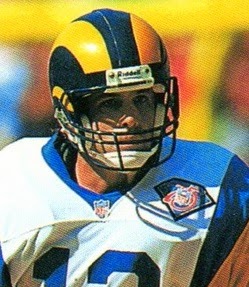
For the Rams, Chris Miller (pictured above) was successful on 16 of 33 throws for 228 yards and two touchdowns, also with no interceptions. Willie Anderson caught five passes for 99 yards and a TD while Todd Kinchen contributed 51 yards on two receptions and had the one 44-yard scoring run, which made him the team’s leading rusher. Jerome Bettis was held to 29 yards on 15 attempts.

San Francisco kept on winning, finishing atop the NFC West with a league-best 13-3 record and going on to thrash San Diego in the Super Bowl. The Rams didn’t win again the rest of the way, ending up at the bottom of the division with a 4-12 tally. It was the franchise’s last season in Los Angeles as it departed for St. Louis the following year.

Jerry Rice led the NFL with 1499 yards on 112 catches that included 13 touchdowns. It marked his ninth consecutive season with over a thousand receiving yards and he was a consensus first-team All-NFL selection for the eighth time and a Pro Bowl selectee for the ninth straight year. Steve Young led the league in passing with a 112.8 rating and in touchdown passes with 35. He received consensus league MVP honors in addition to being a first-team All-NFL choice for the third year in a row and a Pro Bowl selection.